
In a world where information is available with the click of a button, one would think that the average person would be well-informed and in touch with reality. But somehow, this isn’t the case. Conspiracy theories and distorted worldviews have proven to be the norm, not the exception, and many people seem unable (or unwilling) to think critically about the issues that dominate public discussion.
This state of affairs is rather curious, given that one of the core missions of the Western educational paradigm has been to teach critical thinking1. Some research has found that over half of young adults fail tests of critical thinking, and scholars evaluating critical thinking education have characterized this deficit as “severe”2.
Even worse, researchers have discovered that most university professors believe that critical thinking cannot be assessed and have no method of doing so3. Educational researchers have also noted that experts struggle to agree upon a definition for the concept of critical thinking4.
This means that if we want to figure out how to teach critical thinking, we need to first understand what it is. We then need to understand how to teach it and assess it. And finally, we need to design curriculums that make it easy for students to acquire it.
Step 1: Understanding What Critical Thinking Is
If you talk to most educators, they will tell you that critical thinking is a set of cognitive skills that allow someone to evaluate evidence and avoid distorted thinking. But if that were the case, then critical thinking education would not be in the state it is now. Clearly there is something else going on.
When it comes to critical thinking, it may be easiest to understand it using a phenomenological approach, or a common-sense approach.
Let’s consider, for example, the case of an average person who carries an untrue belief about a social issue. Imagine this person encounters a piece of information on the internet that would disprove that belief.
If that person is a critical thinker, they would consume the information, think about it, and maybe even go down some rabbit holes to discover the deeper sources and underlying evidence. After that process of research and thinking, they would then renounce their false belief and move forward in a way that is more reflective of reality.
If this person isn’t a critical thinker, they will reject the valid information. They will experience cognitive dissonance. They will make up excuses for why the information isn’t true.
Historically, most educators have stopped here. They acknowledge that cognitive dissonance happens, but they never really ask why it happens – and what can be done to prevent it.
Step 2: Understanding the Root of Critical Thinking
As I previously mentioned, most educators are aware that critical thinking involves a set of cognitive skills, including knowledge of “fallacies” and common logical errors.
These days, some educators go a level deeper and talk about intellectual virtues, which are fundamental dispositions that orient someone towards critical thinking5. Traits like honesty and openness are considered to be “intellectual virtues” and form the foundation for critical thinking.
Critical Thinking & Intellectual Virtues (Download My Whitepaper)
Talking about critical thinking in terms of intellectual virtues is an elegant approach, but we can go even deeper.
The more that I studied psychology and neuroscience, the more I realized that critical thinking is determined by someone’s ability to remain emotionally regulated in the face of destabilizing information.
When someone is dysregulated by information they don’t like, that means that they are either experiencing that information as a threat to their worldview or personal identity. And therefore, their ability to remain rational and think critically is determined by their ability to face fear and shame.
What we call “cognitive dissonance” is actually driven by the avoidance of fear and shame. Whether or not someone is able to think critically is not just determined by their level of cognitive skill, and it’s not even necessarily driven by their awareness of intellectual virtues. Rather, it is determined by their ability to stay committed to critical thinking even when it feels like their worldview is falling apart.
And this is actually a lot to ask.
Step 3: Teaching Critical Thinking at the Root Level
If educators truly want to teach critical thinking, they are going to have to step beyond cognitive skills and intellectual virtues. They are going to have to start teaching emotional regulation skills, and they are going to have to put students in the position where they experience threats to their worldview and identity. They are going to have to coach students through the process of refining their worldview and self-concept in the face of unpleasant or destabilizing information.
Only then will it be possible to actually teach critical thinking. Learning about fallacies is certainly helpful, and learning about the importance of virtues like honesty is crucial. But without the lived experience of persevering through worldview and identity threat, students will not be able to apply those lessons in the real world. Without the emotional regulation skills that underlie critical thinking, students will tend to default to rationalization, denial, straw-manning, and other “fallacies” that we currently misdiagnose as a lack of cognitive skill.
Solutions I’ve Developed
In my work as an educator and curriculum designer, I’ve actually developed some solutions for educators who want to teach critical thinking.
The first solution I’ve created is a framework for teaching and assessing intellectual virtues, which is available for free on my “Published Works” page.
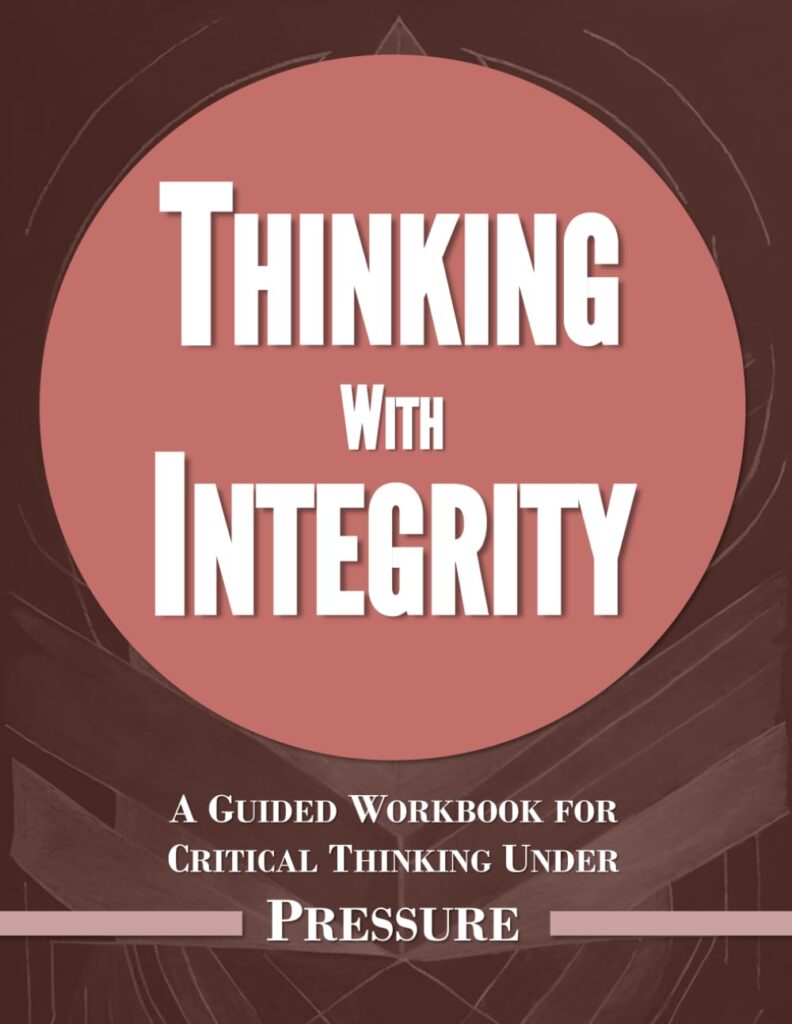
The second solution I’ve created addresses cognitive skills, intellectual virtues, and emotional regulation all in one package. It’s a guided journal called “Thinking With Integrity” that is available on Amazon. If you are an educator who would like to purchase these in bulk, it is possible for me to get you copies below the retail price – just email me at zachary (at) zacharystrong (dot) net.
- Durkin K., “Adapting to Western Norms of Critical Argumentation and Debate”, In: Researching
Chinese Learners, Palgrave Macmillan (2011) ↩︎ - Willingham, D.T., “Critical Thinking: Why Is It So Hard To Teach?”, American Educator (2007) ↩︎
- Bissell, A.N., Lemons, P.P., “A New Method for Assessing Critical Thinking in the Classroom”, BioScience (2006) ↩︎
- Huitt, W., “Critical thinking: An overview”, Educational Psychology Interactive (1998) ↩︎
- Baehr, J., “Intellectual Virtues, Critical Thinking, and the Aims of Education” (2019). Philosophy
Faculty Works. 299. ↩︎